Published: 24/03/05
Author: Professor Ulrich Schimmack, University of Toronto, Department of Psychology
A Case Study of Unscientific Blogs on Psychology Today
I am old enough to know first-hand how the internet and world-wide-web has changed our lives. We have moved from a world with too little information to a world with too much information. In the new world of information overflow, the problem is no longer to find an answer to a question. The new problem is to find the correct or best answer to a question. Even ChatGPT is no help if its sources are filled with inconsistent information and false claims. In this new world, credibility, trustworthiness, and integrity are the new currency. The aim of this new blog is to provide trustworthy information about the results of psychological science. There is a lack of trustworthy information for the general public because scientific journals publish articles written for scientists, journalists lack scientific expertise, and other blogs like the Psychology Today blogs lack quality control.
Sometimes bloggers with opposing agendas will write contradictory blog posts under the Psychology Today brand. Below is an example of two blog posts about marriage and happiness. One claims that marriage typically makes people happier. The other one claims that marriage does not make people happier. I evaluate the scientific evidence presented in these blog posts to show that these blog posts are uninformative or even misleading.
Marriage Makes Most People Happier
The first blog is by Linda and Charlie Bloom, two authors of books on relationships who have been married since 1972.
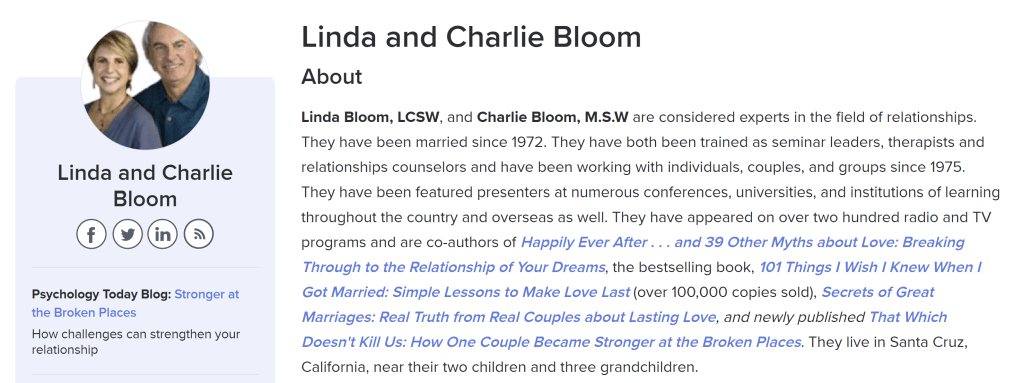
Their blog post “Marriage and Happiness: A direct path to happiness” lists several studies that suggest marriage, on average, increases happiness.
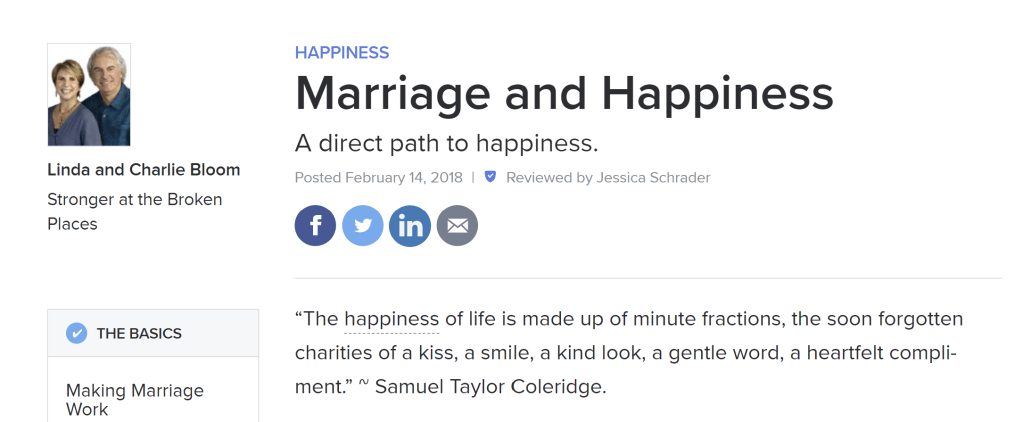
‘To support this claim, they present the following evidence.’To support this claim, they present the following evidence.
The National Opinion Research Center, in Chicago, Illinois surveyed 35,000 Americans over a 30-year period. 40% of married people said they were “very happy” while only 24% of unmarried, divorced, separated, and widowed people said this.
We can fact check this and it is true. Surveys in most countries, including Western countries like the US, show again and again a correlation between marital status and various happiness measures. The problem is that correlation does not prove causality.
Anke Zimmermann and Richard Easterlin are from the University of Southern California. Their research is an overview of the topic of marriage and happiness. They report their findings in a journal article in Population and Development Review (September 2006), “There is a comfortable consensus in the social sciences that marriage has a positive and enduring effect on well-being.”
The problem here is that consensus among researchers is not scientific evidence. Instead, the authors should have mentioned the key finding of the study reported in this article. The key finding was that life-satisfaction increased from singlehood to cohabitation. It then increased again around the time of marriage, but this increase was temporary. After a 1-2 year period, it went back to the level of cohabitation, but not singlehood. The key point is that partnership in the form of cohabitation or marriage leads to a lasting increase in happiness compared to being single.
Here’s what the experts in the positive psychology movement are saying.|
Martin Seligman …, Ed Diener…., Daniel Gilbert ….Eric Weiner… Robert Putnam…Tal Ben-Shahar…. David Myers…. George Valliant… Mihaly Csikszentmihaly…
Again, citing experts’ opinion is not science and there are many examples where famous psychologists have made false claims about happiness. For example, Nobel Laureate Daniel Kahneman has walked back his claim from 2006 that money does not buy happiness. Trust the experts is not science. Presenting empirical results like the results from Zimmermann and Easterlin distinguishes a Scienttific-Psychology blog from a Psychology-Today blog.
Apparently, it’s not just in the United States where marrieds are reaping the happiness benefits of marriage. Using data from the 1991 World Values Study, Steven Stack and Ross Eshleman found that in 16 of 17 industrialized nations, marital status was significantly related to well-being.
While it is interesting to point out that the correlation between marital status and happiness is consistent across most (but not all, which of the 17 countries did not show it?) Western countries, the evidence remains correlational. It does not show that getting married typically is associated with an increase in happiness.
Marriage Does Not Make People Happier
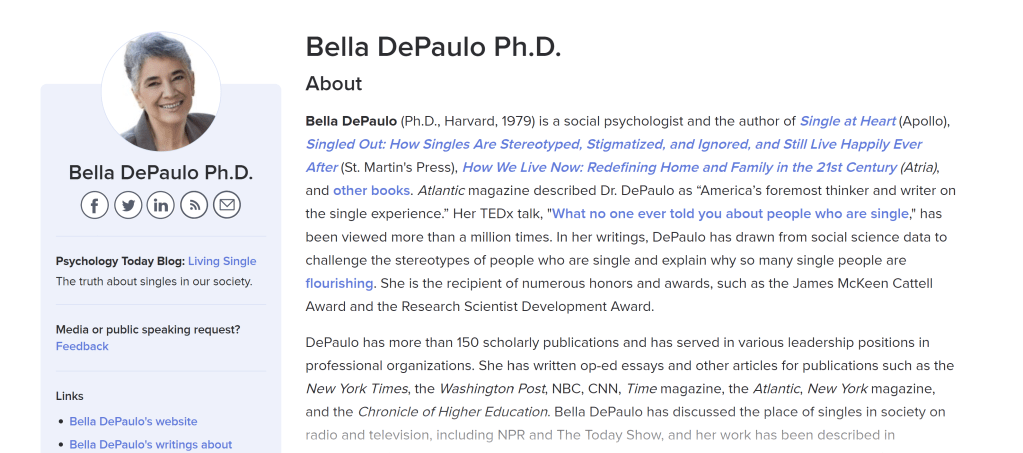
The opposite conclusion is presented as a scientific fact in blog posts by Bella DePaulo, who is proud to have been single her whole life and has written many books on being happy as a single.
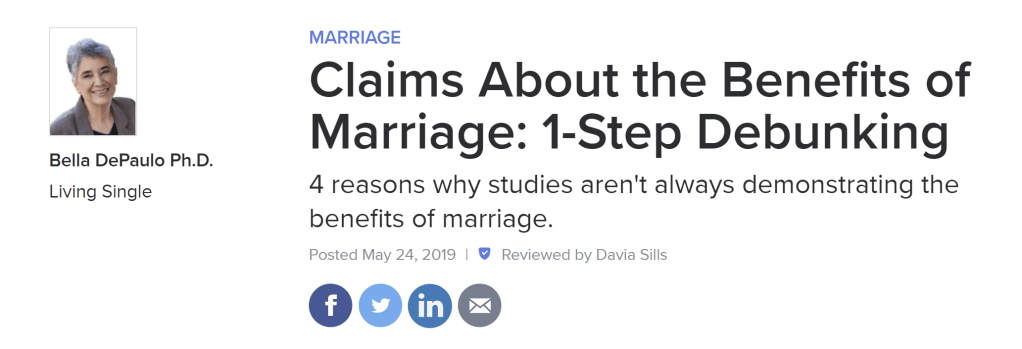
Her blog post aims to debunk allegedly false claims that marriage makes most people happier.
She writes,
A study comparing people who are currently married to people who are not married, at one point in time, and finding that the currently married people look better, cannot definitively show that they did better because they got married.
As pointed out above, this is a valid argument. Correlation does not prove causation. However, correlations do require a causal explanation. If the difference between married and cohabitating people and singles is not caused by benefits of partnership, what else causes the difference?
It’s possible that people who get married are already happier or healthier than single people even before they marry.
This alternative explanation implies that there are other causes that make singles less happy than partnered individuals. This is not really good news for singles. Yes, they would not get happier getting married, but they have some other characteristic that makes them less happy. The question remains what these other causes of unhappiness among singles are.
People who are currently married may differ from people who are not currently married in all sorts of ways.
This is true, but not relevant. What is needed is a characteristic that explains why singles are less happy than married people. Just saying “It is maybe not marriage” is not very helpful. Maybe it is marriage.
Studies comparing only the people who are currently married to people who are not married are often based on a cheater method.
The argument here is that it is unfair to compare married people to singles because some of the marriages end up in divorce and divorced people are less happy than singles. This argument ignores that divorced people do not stay divorced for the rest of their lives. Instead, they find a new partner and are then just as happy as the people who stayed married (Lucas, 2005).
Studies that follow the same people over time are about the best we can do when we are trying to figure out whether marriage makes people happier or healthier. It is really striking that those studies typically show that people who marry do not become happier or healthier than they were when they were single.
It is true that studies that focus on marital status often do not find lasting increases in happiness, but DePaulo ignores the evidence that people are often not single before they get married in Western cultures. People are often with a partner one or more years before they officially marry and when we take this into account people with a partner are happier than those without one (Zimmermann & Easterlin, 2006). It is unclear whether DePaulo is really not aware of this evidence or conveniently ignores it to sell books for unhappy singles. In any case, she neglects important scientific evidence that shows most people get happier when they find a partner and enter into a long-term relationship. This increase lasts for many years. Of course, there is a lot of variability around the average positive effect but on average there is a notable increase in life-satisfaction.
Why We Need Psychology Digest
In conclusion, this blog post showed that Psychology Today blog posts often lack scientific credibility and misinform the public. Psychology Today also has no quality control and allows different bloggers who are selling books on marriage or singlehood to write blogs that promote their agenda rather than providing useful scientific information for the general public. Thus, there is a need for a credible scientific blog about psychological science. This is the aim of Psychology-Digest.com In contrast, to Psychology Today, there will be only one post for each topic. Moreover, there will be a comment section so that psychologists can add information or challenge the conclusions of a blog post. Finally, blog posts will be updated when new information becomes available. I am inviting experts in different areas to write blog posts that provide clear scientific information about issues that are of interest to the general public.
 Psychology Digest
Leave a comment